
04 / MarketRecon
Turning fragmented competitive research into an AI-powered intelligence system
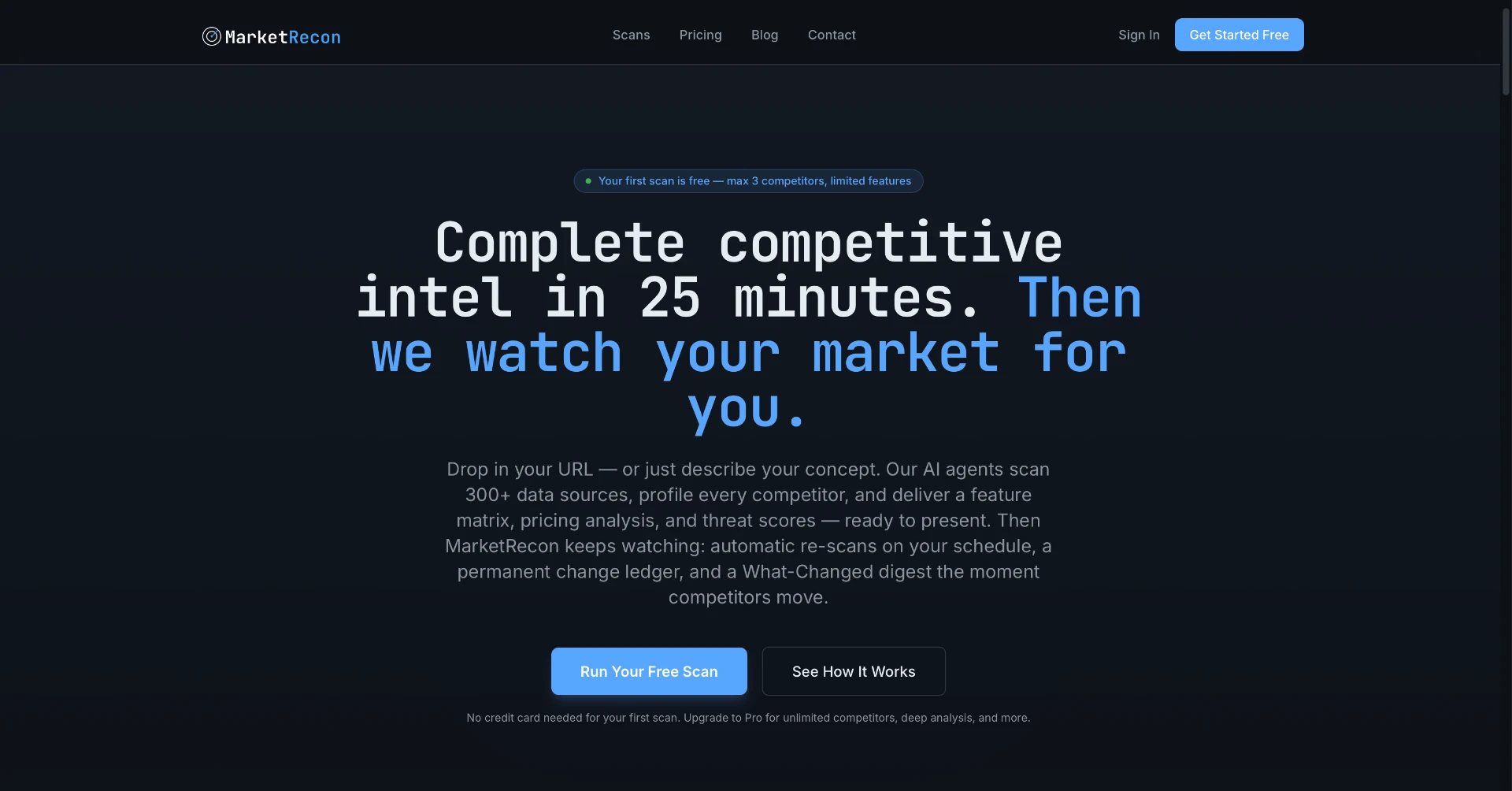
A competitive intelligence product built to convert large volumes of fragmented market information into structured, actionable insight for product and business teams.
- Role
- Product Manager
- Product
- AI-powered B2B SaaS
- Focus
- AI · Product requirements · Prioritisation
Context
Competitive research is usually done by hand: scattered sources, inconsistent formats and findings that go stale as soon as they are written down.
The opportunity was structural rather than analytical — the information already exists, but it is not organised in a way teams can act on repeatedly.
The problem
Teams do not lack market information. They lack a system that collects it consistently, structures it the same way every time and tells them when something has changed.
Fragmentation
Sources are inconsistent in format, depth and reliability.
Staleness
Point-in-time research decays quickly and is rarely refreshed.
Signal vs noise
Volume alone makes insight harder, not easier, to reach.
Actionability
Findings need to arrive in the shape a decision requires.
What I owned
As Product Manager, I shaped product requirements and priorities while working closely with a multi-developer team to turn fragmented competitive information into actionable product intelligence.
Requirements
Translated an open-ended research problem into buildable product scope.
Prioritisation
Sequenced work so the system produced usable output early.
Engineering collaboration
Worked closely with a multi-developer team through delivery.
Product definition
Defined how structured output should be represented and consumed.
My approach
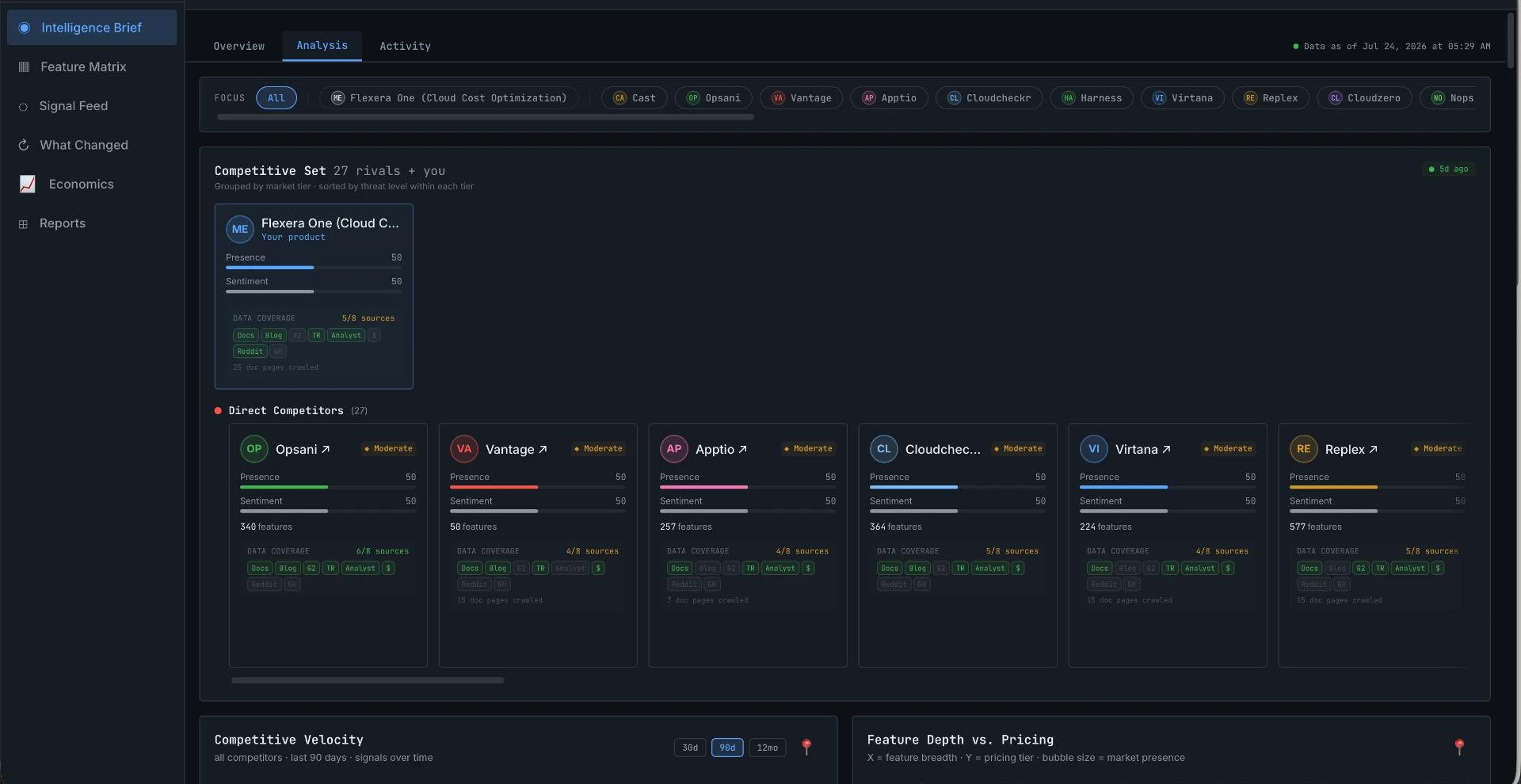
Design the pipeline before designing the interface. If collection and structuring are inconsistent, no amount of presentation makes the output trustworthy.
AI was applied where it is strongest — normalising unstructured input and summarising at scale — while the structure itself stayed explicit and inspectable.
Intelligence products fail at the structuring step, not the analysis step. Consistent structure is what makes insight repeatable.
Key decisions
Product decision
- Context
The system could either produce free-form summaries or enforce a consistent structured schema for every source.
- Options / constraints
- —Free-form output, faster to build and more flexible
- —Structured schema, more constrained but comparable across sources and over time
- Decision
Enforce structure first and treat summarisation as a layer on top of it.
- Why it mattered
Comparability over time is what turns research into monitoring, which is the difference between a report and a system.
System / workflow
The workflow the product automates, end to end.
Trade-offs
Trade-off
More sources widen the picture and dilute reliability. Source handling had to be explicit so users could weight what they were reading.
Trade-off
The system structures and surfaces; judgement about what a change means stays with the team using it.
Execution
- Definition
Turned a broad research problem into a scoped, buildable product.
- Pipeline
Prioritised collection and structuring ahead of presentation.
- AI layer
Applied summarisation and analysis on top of structured records.
- Monitoring
Extended one-off research into continuous change detection.
Outcome
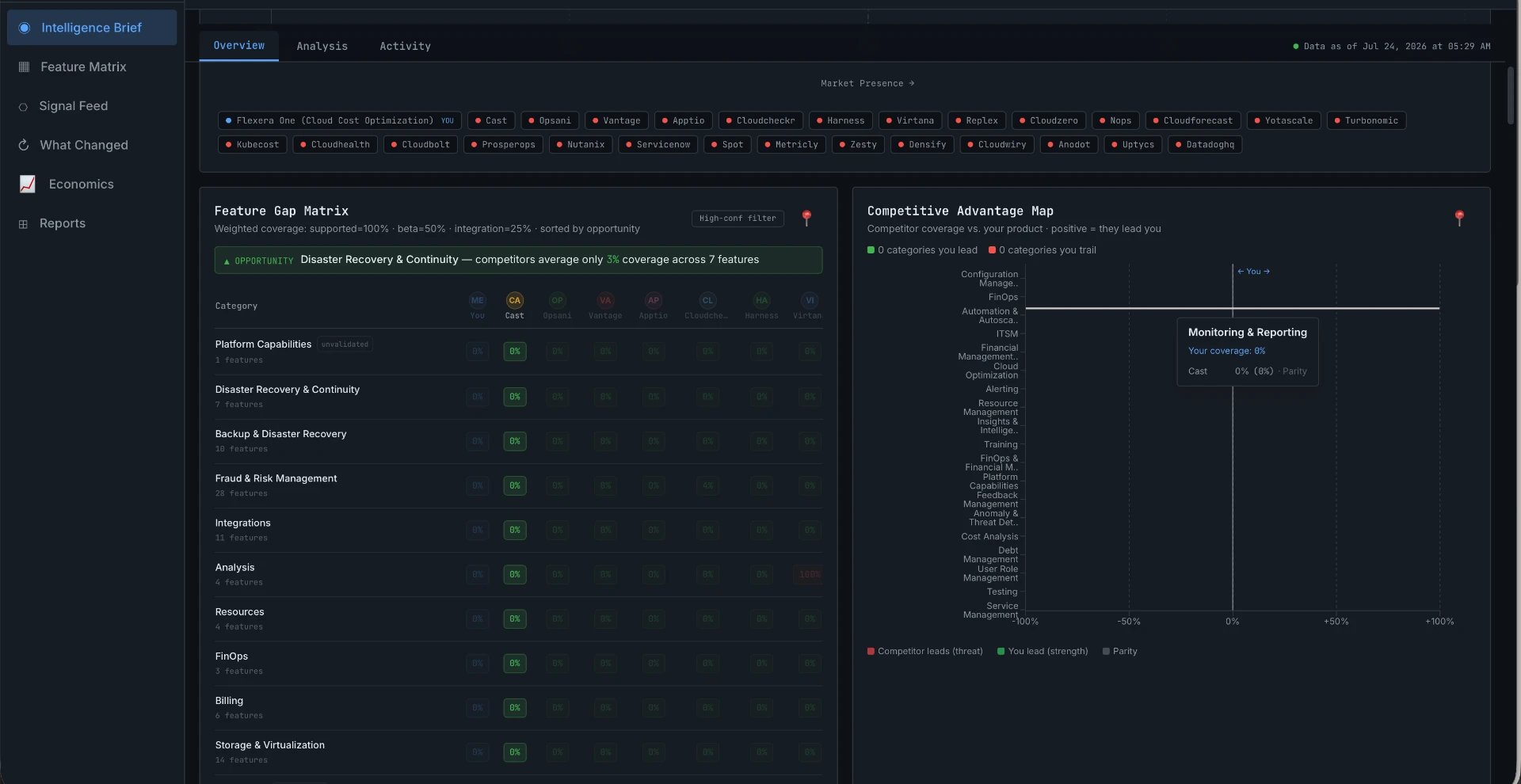
The product moved competitive research from a manual, point-in-time exercise to a repeatable system with consistent structure and ongoing monitoring. Outcome metrics for this project are not published here.
Before
After
Research repeated manually each time it is needed
Collection and structuring handled by the system
Findings stored in inconsistent formats
Comparable records across sources and time
Reflections
Structure before intelligence
AI amplifies whatever structure it is given, including the absence of one.
Scope is the PM's leverage
With a multi-developer team, clear requirements move faster than clever ones.
Monitoring beats reporting
The recurring value is in detecting change, not producing documents.
Next case study
Flexera
Connecting cloud cost visibility with automated optimization through ProsperOps